
How It Was Translated
Here's the short version. We cheated.
Not on the Bible. On the work. Let us explain.
The Old Way to Make a Study Bible
Before AI, making a study Bible was a giant job. You needed a room full of scholars who could read Hebrew and Greek. You needed editors, mapmakers, fact checkers, designers and a publisher with deep pockets. Then you needed years. Lots of them.
The ESV Study Bible was written by a team of 95 scholars and teachers from about 20 denominations. The NET Bible, famous for its 60,000 notes, took about ten years. That's normal. A big study Bible usually takes dozens of scholars, sometimes close to 100, and anywhere from 5 to 15 years.
We had one guy who speaks one word of Greek. And a computer.
Technology Let Us Cheat
Let's just say it out loud. Technology let us cheat, and we're not sorry.
Every time God's people got a new tool, somebody said it was dangerous. And every time, God used it anyway.
- For about 1,400 years, the Bible was copied by hand, one letter at a time. Then the printing press came along, and Martin Luther used it to put the Bible in the hands of German farmers. The church leaders hated it.
- In 1890, James Strong published his famous concordance, a list of every word in the King James Bible. As the story goes, it took him about 100 helpers and around 35 years. Your phone does the same thing before you finish typing.
- Today you can carry 50 translations in your pocket. Nobody calls that a sin. They call it a Bible app.
Some people will say AI has no business near a Bible. Most of them will say it on Facebook, from a phone, with a Bible app open in another tab.
Here's the edgy truth nobody in the Bible business wants to say. For a long time, deep Bible knowledge has been locked behind a gate. The gate was Greek, Hebrew, seminary degrees and $60 commentaries. In Luther's day, the Bible was locked in Latin. Today it's locked in footnotes that only seminary grads can read.
AI is a crowbar for that gate. We're using it.
Some of the people who get mad about this will be scholars. That's okay. Some of the people who got mad at Luther were scholars too.
What AI Did Not Do
Before anyone panics, here's what AI did not do.
AI did not translate the Bible from scratch. AI did not write new Scripture. AI is not inspired. The robot is not the Holy Spirit.
The hard work of translating Hebrew and Greek into English was done by real scholars, a team called the Berean Bible Translation Committee. Which brings us to the Bereans.
Step One: Start With the Bereans
The Town That Fact Checked Paul
In Acts 17, Paul and Silas get run out of Thessalonica by a mob. The believers sneak them out at night, and they land in a town called Berea. Today it's called Veria, and you can still visit it.
Paul goes to the synagogue and teaches that Jesus is the Messiah the Scriptures promised. Here's what the Bereans did next. Acts 17:11 says they received the message with great eagerness and examined the Scriptures every day to see if these things were so.
Think about that. The apostle Paul is standing in front of them. The man who would write 13 books of the New Testament. And they said, in effect, "Great sermon. We're going to go look it up."
And Luke didn't scold them. He called them noble.
You know that one kid in Sunday school? The one with tabs on every book of the Bible, color coded. The one who raised a hand and said, "Actually, Methuselah lived 969 years. Genesis 5:27." The one who reminded the teacher she forgot to give homework.
Now fill a whole synagogue with that kid. That was Berea.
The Bible Named After Them
The Berean Standard Bible is a modern English translation made straight from the Hebrew and Greek. Yes, it's named after those same Bereans. It reads clear and close to the original words, which is exactly what we wanted.
It was made by the Berean Bible Translation Committee, along with Bible Hub, Discovery Bible and OpenBible.com. Then on April 30, 2023, they did something incredibly generous. They gave it away. They dedicated it to the public domain, so anyone can print it, share it and build on it.
We did exactly that. TOM, The Owner's Manual, starts from the Berean Standard Bible.
The Berean team asked one thing. If you change their text, please don't call it the Berean Bible, so the official version stays pure. We respect that. That's why our version has its own name. TOM is built on the BSB, but it's not the BSB, and we never want anyone to mix them up.
We owe the Berean team a huge thank you. Go see their work for yourself at berean.bible.
Step Two: J. Barton Payne's Prophecy Encyclopedia
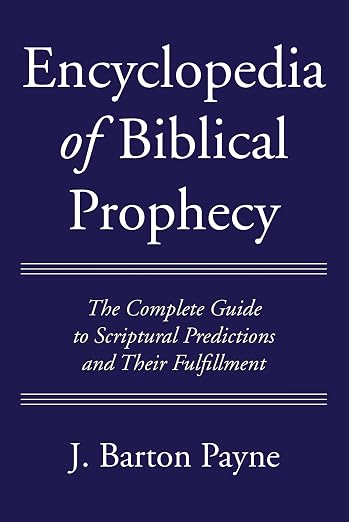
If prophecy is the heart of this Bible, this book was the map.
In 1973, an Old Testament scholar and seminary professor named J. Barton Payne published the Encyclopedia of Biblical Prophecy. He went through the whole Bible and listed every prediction he could find. His count was 1,817 predictions, 1,239 in the Old Testament and 578 in the New, covering 8,352 verses.
Payne did that with books, paper and a whole lot of patience. No computer. No search bar. Just a man, a Bible and probably a lot of coffee.
His work was our starting point.
Why Our Count Is Different From Payne's
Payne found 1,817 predictions. So far we've found 1,052. That's not because we threw out half his list. It's because we counted a different way.
How Payne Counted
Payne spent about 20 years on his encyclopedia. He went through the Bible one book at a time. Inside each book, he grouped every verse about the same subject into one prediction.
Here's an example. Genesis has 12 verses where God promises the land of Canaan to Abraham's family. Payne counted all 12 as one prediction. But when the same land promise shows up again in Exodus or Deuteronomy, he counted it again, as a new prediction for that book.
So Payne's 1,817 is really the number of times a prediction shows up book by book. Behind those 1,817, he listed 737 major subjects. He counted types and foreshadows too, like Old Testament people and events that picture Jesus.
There's nothing wrong with his method. It shows how a prophecy grows as it moves through the Bible. It just gives you a different number than ours.
How We Count
We built our list for a highlighter, not a library. Every entry has to answer one question: what did God say would happen, and where did it happen?
- One prophecy, one entry. Each entry is a prophecy matched to where it came true. When the same prediction shows up more than once, we merged the repeats into one entry instead of counting it again.
- Every entry links both ways. The prophecy points forward to where it came true. The fulfillment points back to where it was promised.
- Every entry gets a color. We sort each one by how it came true: fulfilled in Jesus, a foreshadow of Jesus, fulfilled elsewhere in the Bible, fulfilled in later history or not fulfilled yet.
- Every entry gets an honest rating. HIGH means the match is clear. MEDIUM means good scholars see it, but it takes more explaining. We don't pretend a MEDIUM is a HIGH.
- The 195 still waiting. Prophecies that haven't happened yet get their own color, blue, so you always know what's still ahead.
Our Count Is Still Growing
Payne finished his book in 1973. Ours isn't finished yet. Every time we build a new book of the Bible, we read it line by line, and sometimes we find one more. That's why we say "so far."
When the last book is done, we'll post the final number. And if you think we missed one, tell us. That's what Bereans do.
Step Three: Build the Highlighting Guide First
Most study Bibles start with notes. We started with colors.
Before we touched a single page, we built a highlighting guide. It's the blueprint for the whole Bible. Every category gets one color, like prophecy, fulfillment, archaeology, miracles and the bloodline of Jesus. Every verse gets one color, so your eyes never get confused. And prophecy always wins, because prophecy is the whole point.
The guide grew into two giant lists. One is a prophecy database that matches every prophecy to its fulfillment, both ways. The other is a reference index of famous verses, archaeology, miracles and more.
Once the guide was done, we had a rulebook. Then we could hand the heavy lifting to the machine.
Step Four: Let Claude Do the Heavy Lifting
We used Claude, an AI made by a company called Anthropic. Think of it as a research assistant who never sleeps, never asks for a raise and has read more commentaries than every pastor in Tampa combined.
Here's what Claude helped with:
- Matching every prophecy to where it came true, and every fulfillment back to where it was promised
- Applying the highlighting guide to every verse in all 66 books
- Writing first drafts of the book intros and the funny chapter summaries
- Finding real archaeology photos and checking the photo licenses
- Writing the Big Question pages that lay out every side of a big debate
- Tracking every change from the Berean Standard Bible to TOM
- Laying out the pages so they're ready to print
That's the kind of work that used to take a team of 100 people and a decade. We did the first draft in months.
What a Real Person Did
The robot did the heavy lifting. A real person made the calls.
Nate set the rules. Nate decided what gets highlighted, what gets changed and what stays exactly the same. When he added his own content, it got fact checked first. When something was uncertain, we said so. That's why our notes say HIGH or MEDIUM confidence instead of pretending everything is certain.
On the big debates, like the rapture or spiritual gifts, we don't pick a side and pretend it's the only one. The Big Question pages give every view its best case, with its key verses, and let you decide.
And every page gets read and checked by a real person before it goes to print.
What We Changed From the BSB to TOM
Any time someone changes the Bible text, you should get nervous. We would. So we wrote down every single change.
Almost every change falls into one of four groups.
- God's name. Where the Hebrew has God's personal name, YHWH, we print Yahweh instead of LORD. That's the biggest change by far, in thousands of verses. God said in Exodus 3:15, "This is My name forever." We think He meant for it to be used.
- King James wording. Sometimes the King James just says it better. Daniel 11:32 says the people who know their God shall be strong and do exploits. Try saying that with less punch. You can't. So we brought back some KJV wording, but only when it's faithful to the Hebrew or Greek and still means the same thing today.
- Brackets. Some verses that older Bibles had and newer Bibles dropped are back in TOM, inside [square brackets]. You see the verse, and you see that the oldest copies don't have it. We don't hide anything, and we don't delete anything.
- Modern measurements. No cubits, shekels or talents. We changed them to feet, pounds and dollars so you can actually picture what's going on. Idiot proof, remember?
What We Never Do
We never change a verse to win an argument. We never change a verse to fit a doctrine. If a verse makes our side uncomfortable, it stays exactly as it is.
And we never make a change without telling you.
See Every Change for Yourself
Our change log lists every place where TOM is different from the Berean Standard Bible. Each line gives you the verse, what it said before, what it says now and why we changed it.
Nothing is hidden in the fine print, because there is no fine print.
AI Gets Things Wrong. So Do Scholars.
Let's be honest. AI can be wrong. Sometimes it's confidently wrong, like your uncle at Thanksgiving.
But here's the thing. Scholars with PhDs get things wrong too. That's why there are so many commentaries that disagree with each other.
The answer has never been "trust the experts." The answer is what the Bereans did. Open the Book and check.
So that's what we're asking you to do. The first draft is free. Read it. Check it. If you find a mistake, a note you think is wrong or a view we left out, email us at bibletechsupport@gmail.com. Even the small ones. Especially the small ones. We'll fix it and add it to the change log.
The Bereans checked Paul. You can check us.
See the Whole Bible in Color
Free. No spam. Unsubscribe anytime.